
采购二手工程机械指南:出口买家务必落实的 6 项查验
采购二手工程机械指南:出口买家务必落实的 6 项查验
公司新闻
2026-08-11
The biggest worry for an export buyer is simple: you can't stand next to the machine, so how do you avoid a bad unit? Refurbished machines sold as original, rolled-back hour meters, flood-damaged units hidden under fresh paint — without a clear standard, these are hard to catch.
This guide isn't about brands. It's about the machine itself: the six things that tell you the real condition of a used excavator, wheel loader, or bulldozer. Learn these and you have your own yardstick when you request a quote, watch a video, or read an inspection report.
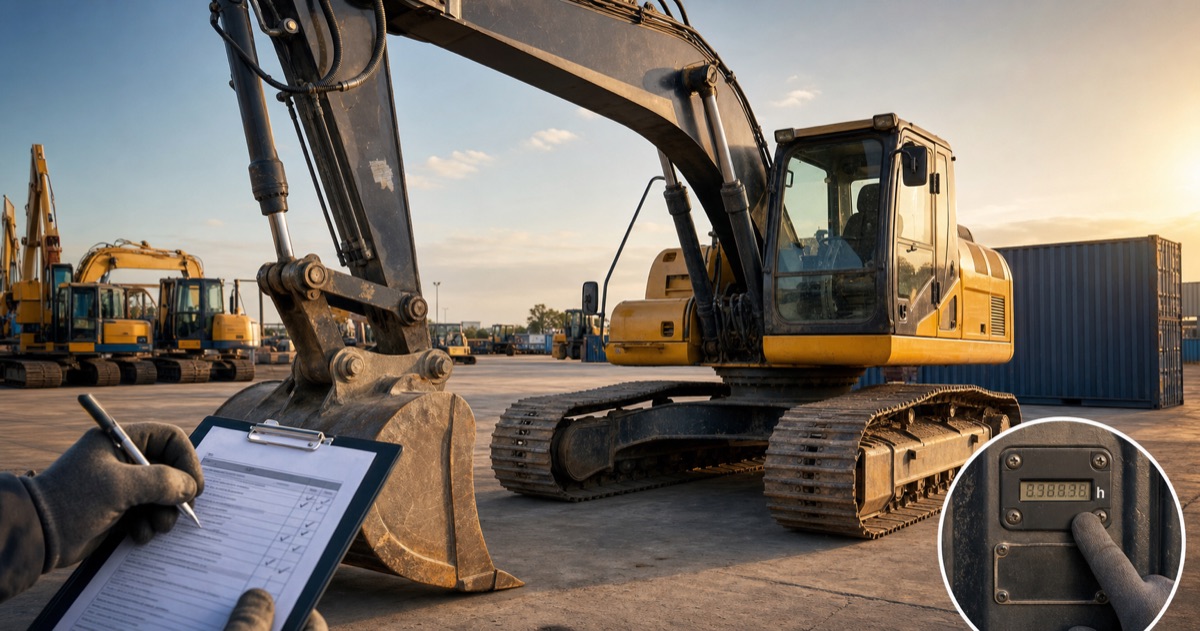
1. Working hours matter more than the model year
To judge how worn a used machine is, working hours tell you more than the year it was built. Two five-year-old excavators can be in completely different shape — one with 4,000 hours, the other with 12,000.
As a rough guide for a mid-size hydraulic excavator:
- Under 6,000 hours — usually still in good shape; major components have limited wear.
- 6,000–10,000 hours — moderate use; pay close attention to the engine and hydraulic system.
- Over 10,000 hours — most models are approaching a major-overhaul cycle. The price should fall noticeably, and you should confirm whether an overhaul has already been done.
Quick check: under normal single-shift work, a machine typically runs 1,000–2,000 hours a year. Multiply the machine's age by that range to sanity-check whether the displayed hours look reasonable.
2. Age and hours have to be read together
Hours alone aren't enough. A machine with only 3,000 hours but 15 years of age has likely sat idle for long stretches — which brings its own problems: perished rubber, hardened oil seals, oxidized wiring.
A healthy used machine is one where age and hours roughly match. When the two are badly out of step — either long idle or a tampered meter — it's worth one more question and one more check.
3. Brands behave differently on the used market
Major brands do perform differently second-hand. Match the brand to your own working conditions and local parts supply:
- Caterpillar, Komatsu — high resale value, mature global parts networks, easy long-term maintenance.
- Hitachi, Kobelco — strong reputation for hydraulics; well suited to high-output digging.
- Volvo, Doosan, Hyundai — strong all-round value for money.
- SANY, XCMG — affordable new, friendly used prices, with parts supply increasingly solid across emerging markets.
There's no single "best" brand — only the one that fits your local conditions, parts availability, and budget.
4. Condition grades: read what the seller is actually saying
The trade uses condition grades to describe a machine's appearance and state, but the standards aren't consistent between sellers — so never judge on a single letter or star rating. Read the grade alongside two things: detailed real photos, and a third-party inspection report. The written grade is a hint; the images and the data are the evidence.
5. Where to look: spend your attention where the money is
A used machine's value sits in a handful of high-cost components. When you inspect it — or when you ask the seller for targeted footage — confirm these first:
- Engine — any abnormal noise, blue or black smoke, or oil leaks; does it cold-start cleanly?
- Hydraulic system — any seepage at the cylinders, movement that is smooth and free of jerks, clean oil.
- Undercarriage and tracks — wear on tracks, chains, and rollers; this is expensive to replace.
- Boom and structure — cracks or re-welds at the seams, excessive play in the key pins.
- Overall consistency — large areas of repaint (which can hide accident or rust damage), and a clear, matching nameplate and serial number.
Focusing on these high-value parts protects you from large losses far more than fussing over a scratch or two.
6. Documentation: especially complete for export
In a cross-border deal, paperwork is trust. Whether a machine is worth buying often comes down to whether it can show complete supporting documents:
- Third-party inspection report — an objective record of hours, condition, and key components.
- Machine number (PIN / serial) — used to verify origin and avoid a problem unit.
- Export and customs documents — proforma invoice, packing list, certificate of origin; these decide whether the unit clears at the destination port.
- Real footage — multi-angle photos, a cold-start video, an operation demo; the more complete, the smaller the information gap.
In short: a seller who provides this material openly and completely is usually the one worth trusting.
The bottom line
Judging a used machine isn't down to luck — it's down to standards. Run through working hours, age, brand behavior, the high-value components, and the supporting documents one by one, and you can spot most bad units before you ever place an order.
Every machine we supply comes with multi-angle real photos and a third-party inspection report — hours, condition, and serial numbers all transparent — so even from the other side of the world, you can buy with a clear picture.